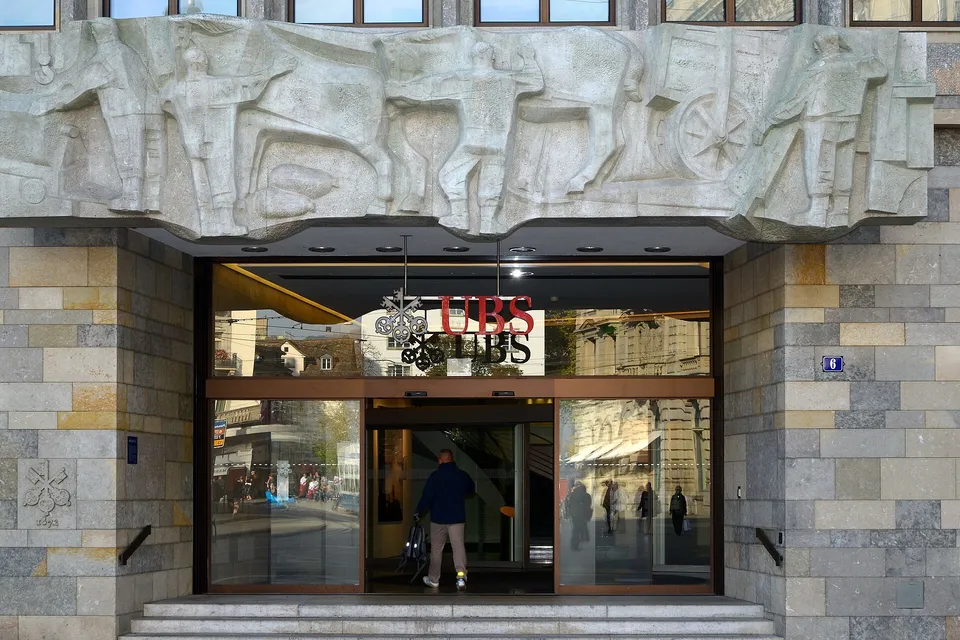
Swiss parliamentarians face a complicated decision regarding stricter capital regulations for the major bank UBS following the 2023 collapse of Credit Suisse. Setting requirements too high could prompt Switzerland's largest bank to consider relocating abroad, whereas overly lenient rules might trigger a referendum that blocks the reform and prolongs market uncertainty.
A committee of the National Council, the large chamber of the parliament, begins deliberations on the legislative proposal on October 26. In September, the Council of States, the small chamber of the parliament, decided that UBS must back its foreign subsidiaries with 90 percent common equity Tier 1 (CET1) capital. Previously, this quota stood at 60 percent, with a portion of the funds covered by cheaper additional Tier 1 (AT1) bonds. The Swiss government proposed a 100 percent requirement, while the Social Democratic Party has threatened a public vote if this proposal is diluted excessively.
UBS has previously labeled the 90 percent core capital proposal as excessive and warned of competitiveness losses. Major shareholders such as Artisan Partners have publicly urged the bank to leave Switzerland due to looming regulations. Leo Müller, a committee member and Nationalrat for the Centre Party, noted the difficult position of the parliament, explaining that a diluted bill risks a popular rejection, while overly stringent rules could cause the bank to view Switzerland as a difficult business location and look elsewhere.
Hans-Peter Portmann of the liberal FDP has proposed a 75 percent hard equity requirement for the foreign units of UBS, combined with a mechanism designed to strengthen the bank's loss-absorbing capacity if capital quotas fall below a specific threshold. Additional proposals are expected to emerge ahead of the National Council debate anticipated in December.
Representatives from parties across the political spectrum told Reuters that the hurdles for softening the 90 percent proposal are substantial. The National Council features stronger representation of parties to the left of the centre compared to the Council of States, while centre and bourgeois parties remain either divided or inclined toward a firmer stance. FDP lawmaker Olivier Feller, who personally supports a 100 percent CET1 backing for UBS foreign units, stated his personal assessment that the National Council might settle at 90 percent, adding that Switzerland is a small country for a large bank. The official position of his party remains undecided.
UBS has repeatedly stated its intention to remain in Switzerland. However, insiders indicate the institution is working on contingency plans to respond to potential unfavorable outcomes from parliamentary deliberations, including moving its headquarters or merging with another financial institution. Despite these preparations, experts consider an exit of UBS from Zurich unlikely. Urs Saxer, a Zurich law professor, noted that the stability and legal certainty offered by Switzerland are not easily found elsewhere, meaning UBS will not act irrationally.