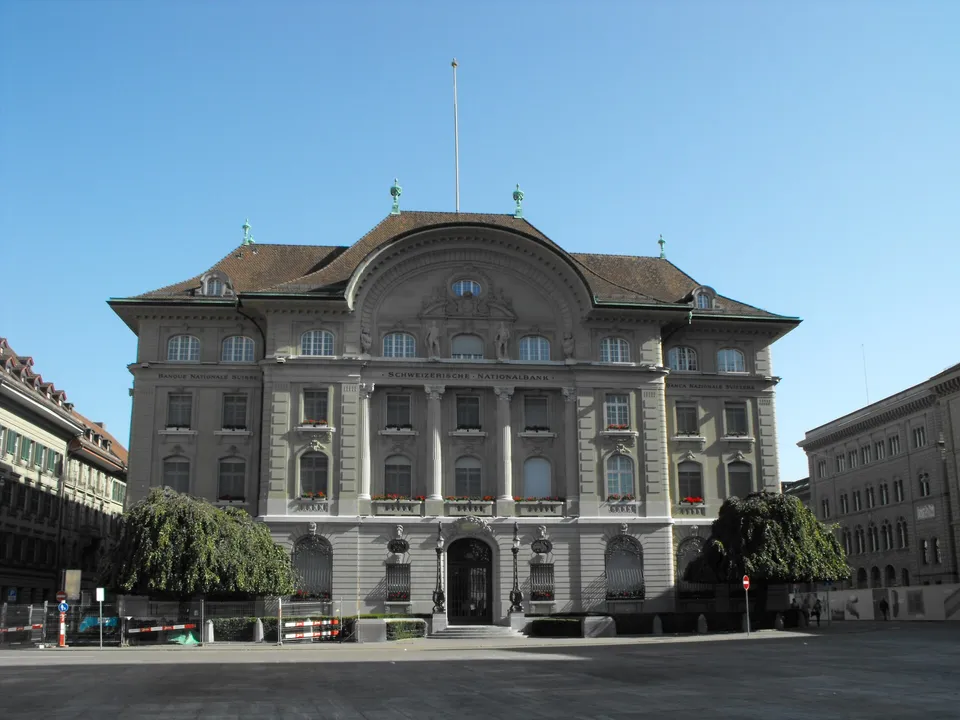
The Swiss National Bank kept its key interest rate at 0% on Thursday, defying a tightening cycle among major peers including the European Central Bank, U.S. Federal Reserve and Bank of Japan, which have begun raising interest rates to counter rising inflation. The central banks of Canada and the U.K. are expected to follow later in the year.
Switzerland's annual inflation rate ticked up to 0.8% in August, driven by higher gasoline, diesel and heating oil costs, remaining well below levels in the U.S., U.K. and euro zone. While those central banks target 2% inflation, the SNB aims to keep inflation between 0% and 2%. SNB Chairman Martin Schlegel stated that policymakers decided to keep rates unchanged based on the inflation picture, noting that forecasts suggest inflation will rise somewhat in the fourth quarter before declining over 2027 as energy inflation eases. Average annual inflation is forecast at 0.7% in 2026, 0.8% in 2027 and 0.8% in 2028.
Traders are pricing in roughly 50-50 odds for a hike versus a hold in December, with over a 90% chance of a hike by early 2027. LSEG data indicates traders expect the key rate to reach at least 0.75% by next September. UBS economists noted that the falling value of the franc, elevated oil prices and resilient U.S. and euro zone economies increase the likelihood of an earlier hike, though the SNB maintains a history of surprising markets.
The Swiss franc's safe-haven status exerts deflationary pressure by making imports cheaper as the currency appreciates. In 2025, the franc rose more than 12% against the dollar as investors sought protection from market volatility, though the greenback has clawed back about 4% this year. Schlegel noted that uncertainty remains high and reaffirmed the bank's willingness to intervene in the foreign exchange market if necessary, pointing to interventions in early March following the outbreak of war in Iran to prevent a sharp appreciation of the franc.
Gedeon Tumong, head of finance specialization at HIM Business School, noted that Switzerland imports credibility alongside goods, supporting the franc and curbing imported inflation. Energy accounts for about 3.5% of the Swiss inflation basket compared with roughly 7% in the euro zone, aided by alternative sources like hydropower and nuclear power. Antonio Fatás, an economics professor at INSEAD, pointed out that adjusting Switzerland's 0% nominal rate for its 0.8% inflation yields a real interest rate of -0.8%, which is comparable to real rates in the euro area, U.K. and U.S.