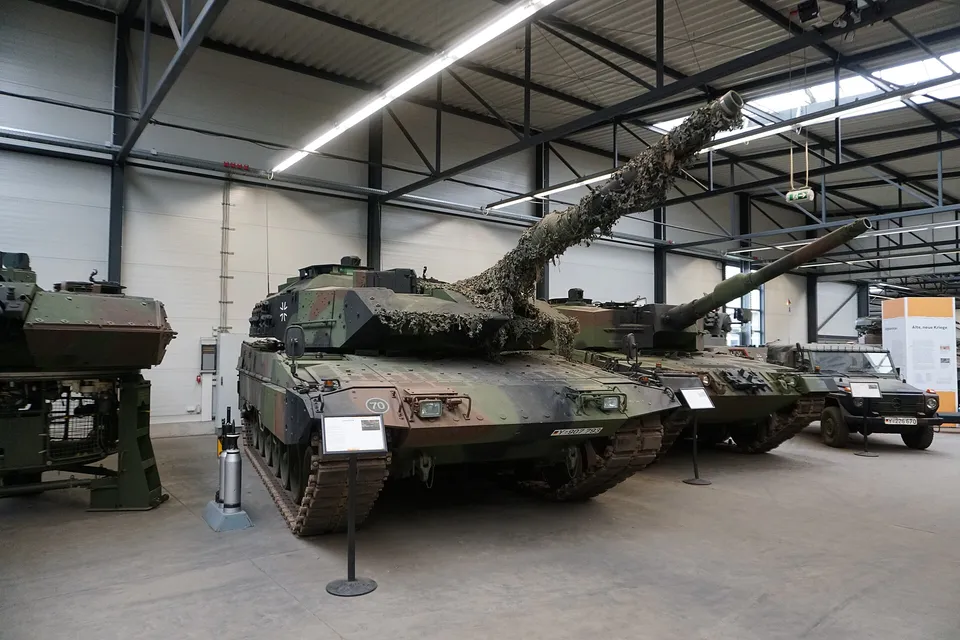
For two decades, Britain was unable to supply barrels for its tanks without purchasing them from abroad. Relying on foreign allies appeared to be a reasonable choice during years of relative security following the end of the cold war. However, Russia's full-scale invasion of Ukraine in 2022 altered that calculation, prompting a rearmament scramble among European nations, including the United Kingdom.
Evidence of that shift was visible in Shropshire on Thursday, where UK defence secretary Wes Streeting opened a factory hastily constructed by Germany's Rheinmetall to manufacture barrels for artillery and British tanks. The urgency was such that Rheinmetall chief executive Armin Papperger stated the company initiated investment off the back of a handshake before Christmas with Gen Sir Roly Walker, who serves as chief of the general staff, without waiting for a formal contract.
Eight months later, production of the first barrels at the Telford facility has commenced. Papperger indicated that he is also in discussions to produce more ammunition in the UK, with a decision expected in the next six to eight months. Streeting remarked that it is insufficient to merely out-innovate adversaries, emphasizing the need to out-produce them as well, given that advantage increasingly belongs to those capable of manufacturing at scale and fielding capabilities fastest.
The manufacturing process begins with a 3.2-tonne, 8-metre cylinder of specialized steel alloy, into which a hole is drilled to form the barrel shape. Surfaces are subsequently honed to remove imperfections, after which a turning tool introduces spiral rifling to enhance artillery accuracy. A specialized machine, described as one of only two in the world, increases internal pressure to approximately 15,000 times sea-level air pressure, hardening the material to withstand the explosive power required to propel shells up to 30 kilometres, or 18 miles.
While the conflict in Ukraine is noted for the rise of drone warfare, Walker asserted that uncrewed weapons cannot rival traditional armaments in terms of sheer firepower. Highlighting that both sides in Ukraine fire tens of thousands of rounds of artillery ammunition daily, he noted this generates a weight of fire and lethality that drones alone cannot replicate. Walker expressed regret over the cessation of British artillery manufacturing in 1967, which had previously endured through the Napoleonic wars, two world wars, and the cold war at the Royal Arsenal in Woolwich.
The new Telford gun hall restores that domestic manufacturing capability, initially focusing on barrels for German-made, self-propelled, remote-controlled howitzers utilizing Nato-standard 155mm ammunition. Future operations will additionally produce slightly smaller tank barrels using 120mm rounds, which include the Challenger 3 tank currently undergoing final testing, alongside a British variant of the remote-controlled howitzer planned for deployment after May 2028.
The facility is designed to produce 245 barrels annually, alongside 50 breeches, though Papperger noted that annual capacity could theoretically expand to as many as 1,000 units within four or five years should orders materialize, with exports also considered. Papperger added that Nato allies can manage with smaller output volumes than Russia and its client states due to superior quality, estimating that a Russian barrel fires approximately 500 times before breaking, whereas products from Telford are expected to withstand up to 4,000 shots.
The Telford investment followed a 2024 agreement between then prime minister Keir Starmer and German chancellor Olaf Scholz, forming part of a broader pact for closer cooperation between Europe's two largest military spenders. Rheinmetall employs about 685 people in Telford, with 35 working in the gun hall, a figure projected to reach 100 at full capacity. The majority of the site's workforce manufactures Challenger and Boxer armoured vehicles through a joint venture with BAE Systems.
Rheinmetall has emerged as a primary beneficiary of increased European defence spending and arms supplies to Ukraine. US intelligence services reportedly foiled a Russian plot in 2024 to assassinate Papperger in connection with the company's weapons production for Kyiv. The German firm's market value rose from approximately €4.2 billion, or £3.5 billion, prior to Russia's invasion to €47 billion on Wednesday, despite pulling back from peaks reached last year. Rheinmetall, along with European counterparts such as BAE Systems and Rolls-Royce, has gained from European governments seeking to diminish reliance on the US arms industry amid shifts in Washington's policy.
Papperger noted that a growing number of governments are seeking control over their weapons production, which may address concerns raised by US president Donald Trump regarding alliances. Emphasizing the industrial foundation required for defence partnerships, Papperger stated that strong armies require a strong industry, which the company is currently working to build.