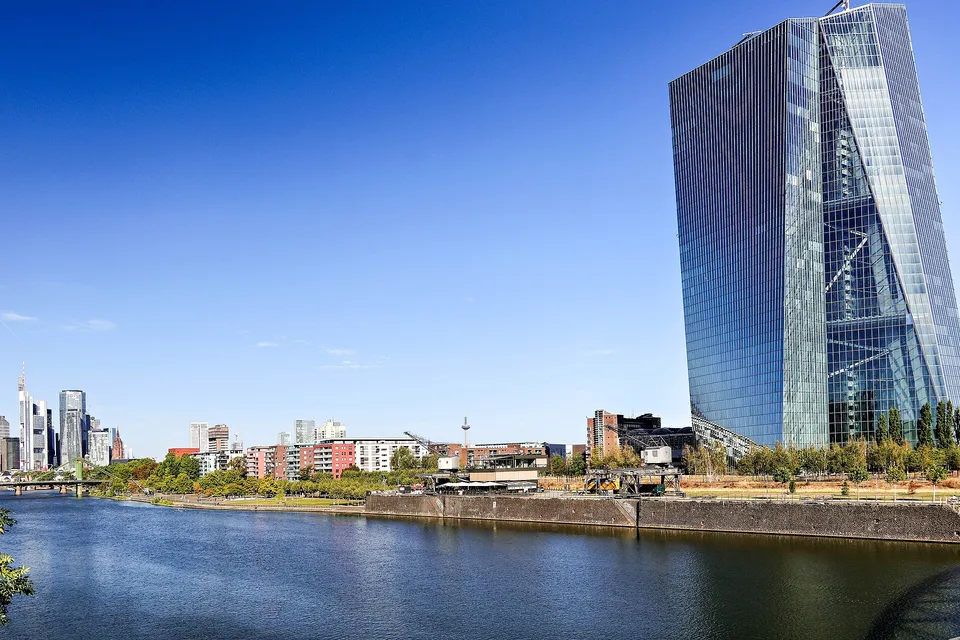
The European Central Bank Governing Council decided to keep the three key ECB interest rates unchanged during its meeting in Frankfurt am Main. ECB President Christine Lagarde and Vice-President Boris Vujčić outlined that continuous increases in energy prices are presenting upward risks to the inflation outlook alongside downward risks to the growth trajectory. Although the full impact of the energy shock continues to unfold, underlying inflation has stayed broadly stable overall, and wages have not demonstrated a material response thus far. The extended magnitude and duration of the energy shock, together with implications for indirect and second-round effects, are expected to push inflation upward and decrease growth. Financing conditions have experienced tightening since the previous meeting, which is anticipated to exert downward pressure on both inflation and growth. The central bank remains committed to directing monetary policy so that inflation stabilizes at the 2 percent target over the medium term.
Policymakers remain well positioned to navigate prevailing elevated uncertainty, maintaining a data-dependent and meeting-by-meeting strategy to define the appropriate monetary policy stance. Interest rate decisions will rely specifically on assessments of the inflation outlook and associated risks, taking into account incoming economic and financial data, underlying inflation dynamics, and monetary policy transmission strength. The central bank has not pre-committed to any specific rate path.
Incoming economic data indicate that the euro area economy continued expanding during the third quarter of the year. Services recovered following an initial softening at the start of the conflict in the Middle East. Manufacturing, digital services, and exports are benefiting from artificial intelligence-related business investments, while government expenditures on infrastructure and defence also provide support to activity. These elements are expected to sustain growth in the near term. Conversely, renewed energy price rises have dampened consumer confidence, and elevated financing costs are projected to weigh on growth.
The unemployment rate stood at 6.4 percent in August. Employment and labour force growth remain subdued, whereas productivity has shown a gradual pickup. Over the medium term, recovery in confidence and real incomes, supported by gradually declining energy prices and a resilient labour market, should strengthen domestic demand. Investments in artificial intelligence activities and government outlays for infrastructure and defence are expected to continue supporting growth, while export growth should accelerate alongside strengthening foreign demand.
Higher potential growth necessitates structural reform backed by sound public finances. Fiscal sustainability serves as an essential anchor for broader economic stability, and fiscal responses to the energy shock should remain temporary, targeted, and tailored. Simplifying and harmonizing rules across the Single Market of the European Union, accelerating the energy transition, and completing the savings and investments union represent fundamental building blocks for a more dynamic and resilient economy. As the legislative framework for the digital euro approaches its final stage, agreement on the Single Currency Package is emphasized as urgently required.
Inflation increased to 3.8 percent in September, up from 3.2 percent in August. Energy price inflation climbed markedly to 18.9 percent from 14.3 percent in August, driven by diesel and petrol prices reaching new peaks in September, partly due to elevated refining margins. Inflation excluding energy rose to 2.3 percent in September from 2.1 percent in August, while food price inflation advanced to 1.3 percent from 1.1 percent. Services inflation moved up to 3.2 percent in September from 3.0 percent, whereas goods inflation decreased to 1.1 percent from 1.2 percent.
Underlying inflation indicators have remained broadly stable, although the early pricing chain stages indicate upward pressures. Wage pressures remain moderate, with compensation per employee expanding by 3.3 percent in the second quarter, decelerating from 3.6 percent in the first quarter, while rising productivity helped contain unit labour cost growth. The forward-looking wage tracker indicates negotiated wage growth will range between 2.5 percent and 2.8 percent during the remaining months of 2026, averaging 2.6 percent across the first three quarters of 2027. Shorter-term inflation expectations have risen, whereas most longer-term measures remain anchored around 2 percent.
Energy prices have surpassed the baseline path projected in September by ECB staff, which is likely to accelerate near-term inflation and maintain headline inflation significantly above target through coming quarters. Subsequently, declining energy inflation combined with higher interest rates should facilitate the return of inflation toward the target.
Risks to the growth outlook tilt to the downside, driven particularly by the Middle East conflict and ongoing developments in Russia's war against Ukraine. Continued disruptions in energy supplies could drive energy prices higher for longer than anticipated, weighing on real incomes, spending, and investment. A deterioration in global financial market sentiment or intensifying spillovers in global bond markets could tighten financing conditions and suppress demand. Fiscal uncertainty might likewise tighten financing conditions and impair confidence, reducing consumption and investment. Furthermore, renewed trade tensions between major economies risk further supply chain disruptions, lower exports, and weakened consumption and investment. Conversely, growth could surprise on the upside if the economy and energy markets adapt more swiftly than expected to conflict disruptions, or if conflicts achieve sustainable resolution. Technological adoption by euro area firms, government infrastructure and defence spending, and reforms enhancing productivity and completing the Single Market could also stimulate higher growth.
Risks to the inflation outlook lean to the upside, stemming primarily from the Middle East conflict and the war in Ukraine. The energy shock could intensify, with stronger-than-anticipated spillover effects on other prices and wages. Gas prices could surge amid further supply disruptions or an unusually cold winter combined with low storage levels. Prolonged high energy prices increase the likelihood of broader inflation driven by indirect and second-round effects. Renewed trade tensions could cause further global supply chain fragmentation, curtail critical raw material supplies, and worsen capacity constraints in the euro area. Extreme weather events, potentially reinforced by El Niño conditions and broader climate crises, could drive food prices higher than expected. Conversely, lower inflation could materialize if geopolitical conflicts are resolved sustainably or if indirect and second-round energy price effects prove less pronounced than anticipated, alongside more volatile financial markets and higher long-term interest rates weighing on demand.